
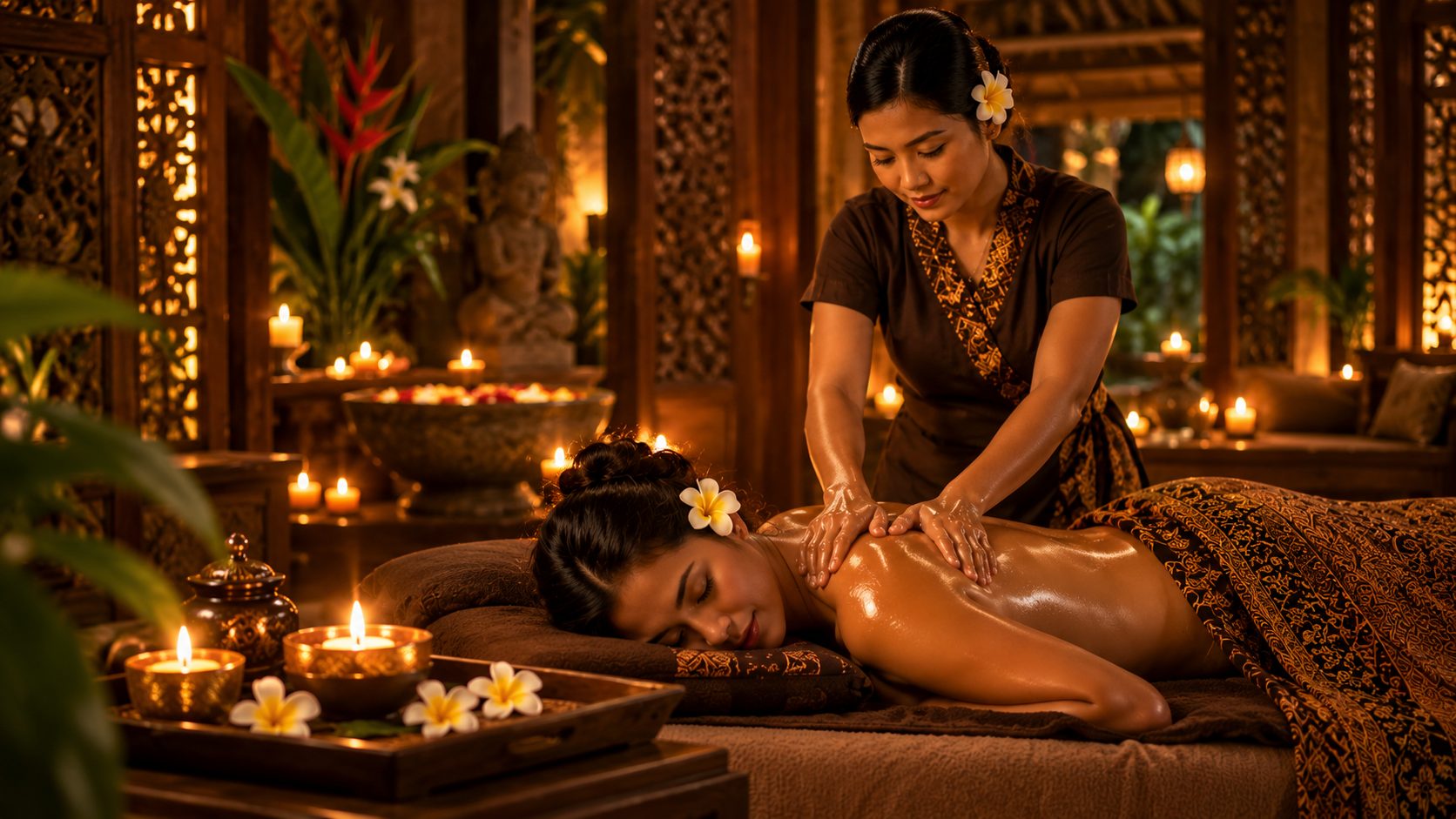
Balinese massage is a body massage technique originating in Bali, Indonesia, that combines kneading, thumb pressure, long gliding strokes, and gentle stretching, applied with warm oil on a massage table. Its goal is to relieve muscle tension and induce deep relaxation, in sessions that typically last between 60 and 90 minutes.
Before booking a first session, the most common questions are three: what Balinese massage is, where it comes from, and what a session is like. This guide explains its origin in traditional Balinese medicine, the techniques and oils it uses, and how a session unfolds step by step. It also covers its benefits, who it is indicated for, and the differences with Thai massage, Lomi-Lomi, and Shiatsu.
Balinese massage in four points
- What it is: an oil body massage combining kneading, acupressure, gliding strokes, and stretching.
- Origin: traditional Balinese medicine, passed down by healers called balian and recorded in manuscripts called lontar usada, with Indian roots.
- Pressure: medium to firm, and the therapist adapts it to each person.
- Duration: from 30 to 120 minutes, although the most common formats are 60 and 90 minutes.
What is Balinese massage?
Balinese massage is an Indonesian traditional body massage performed on a table with warm oil. It combines pressure with thumbs and palms, kneading, long strokes, and passive stretching over the entire body, with medium or firm pressure, to relieve muscle tension and induce deep relaxation.
Balinese massage is not based on a single gesture, but on the combination of several techniques within the same session. Gliding strokes with oil warm up and prepare the musculature. Kneading and thumb pressure work on the areas with the most tension, such as the back, shoulders, and legs. Stretching closes the work and restores mobility.
Outside Indonesia, the “Balinese massage” label is used in spas for an oil massage style inspired by that tradition, and each center interprets it in its own way. That is why the pressure, oils, and duration change from one menu to another. In Bali, however, massage is part of a broader traditional medicine system.
What “pijat” means and the role of massage in Bali
“Pijat” is the Indonesian word for massage. The Kamus Besar Bahasa Indonesia (KBBI), the official Indonesian dictionary, includes two meanings for the verb “pijat”: pressing with the fingers and rubbing body parts to relax the muscles and promote blood circulation. Hence the expression “pijat Bali”, used on the island to refer to traditional Balinese massage.
In Bali, massage has a therapeutic dimension. It is part of usada, traditional Balinese medicine, practiced by healers called balian and recorded in manuscripts of Hindu tradition. The Balinese massage offered in spas today stems from that tradition, although adapted to a wellness and relaxation context.
Where does Balinese massage come from?
Balinese massage comes from the traditional medicine of Bali, passed down by healers called balian and recorded in palm-leaf manuscripts known as lontar usada. This medicine has Indian roots: it arrived on the island along with Hinduism, which is today the majority religion in Bali, and the Ayurvedic tradition. That is why many centers describe Balinese massage as a technique with Ayurvedic foundations.
Massage occupies an explicit place in these manuscripts. A study by Putu Lakustini Cahyaningrum and I Ketut Ardhana, published in 2023 in the Journal of Economy Culture and Society, analyzes how the lontar usada treat “tuju”, an ailment comparable to rheumatism. The study includes three treatment pathways: massage (uut), inner energy work, and herbal preparations, including ginger.
Techniques used in Balinese massage
Balinese massage combines five manual techniques within the same session: long gliding strokes with oil, muscle kneading, thumb acupressure, passive stretching, and reflex work on hands and feet. The therapist uses their palms, thumbs, fingers, and, in some centers, forearms.
- Long gliding strokes: broad and continuous movements with warm oil on the back, legs, and arms. They serve to warm up the tissue and set the pace of the session.
- Kneading: pressure and release of the muscle mass, especially on the shoulders, trapezius, lower back, and calves, which is where tension accumulates the most.
- Acupressure: sustained pressure with the thumbs on specific points, along the back and on the soles of the feet.
- Passive stretching: the therapist mobilizes the arms, legs, and spine without forcing the joint. These are usually reserved for the end.
- Reflex work: pressure on feet and hands, often during the phase when the person is facing up.
The order and weight of each technique change depending on the center and what the recipient needs. A person with a lot of tension in the cervical area will receive more kneading and acupressure on the shoulders and neck. If they are looking to disconnect, there will be more long gliding strokes.
Is Balinese massage strong or gentle?
Balinese massage is usually applied with medium or firm pressure, more intense than a classic relaxation massage and less than a deep tissue massage. The intensity is not fixed: the therapist adjusts it to each person’s tolerance.
Centers do not agree on the intensity. Some spa menus describe it as a deep pressure massage over almost the entire body, while others speak of gentle and rhythmic movements. Slow Bali Spa defines its Balinese Signature Massage as a medium pressure massage, applied with palms and thumbs and with warm oils.
During a Balinese massage, it is normal to feel intense pressure in tight areas, but not sharp pain. The Mayo Clinic warns that a slight muscle discomfort may appear after a massage, but that strong pain should not be felt during the session. If the pressure is excessive, simply tell the therapist at that moment.
What oils are used in Balinese massage
Balinese massage is always done with oil, and it is usually applied warm. It is customary to combine a base oil, which allows the hands to glide, with essential oils that provide scent. The choice depends on the center and, in many cases, on the preference of the person receiving the massage.
What a Balinese massage session is like, step by step
A Balinese massage session usually follows six phases: initial consultation, preparation on the table, warm-up with oil, deep work on the musculature, stretching face up, and a brief final rest. The order is quite consistent across centers, although the duration of each phase depends on the booked time.
- Initial consultation. The therapist asks about areas of tension, preferred pressure, and any health issues that might advise against the massage.
- Preparation. The person receiving the massage undresses to their comfort level and lies face down on the table, covered with a towel or sheet. Only the area being worked on is uncovered at any given time.
- Warm-up. The therapist applies warm oil using long gliding strokes on the back, legs, and arms.
- Deep work. This is the phase of kneading and acupressure in the most tense areas: trapezius, lower back, glutes, and calves.
- Stretches and closure. The person turns face up. The therapist works the arms, legs, and feet, finishing with passive stretches and slow movements.
- Rest. A few minutes lying down before getting up helps prevent dizziness and prolongs the feeling of relaxation.
For someone who has never received an oil massage, the guide on getting a massage for the first time details how to prepare, what clothes to wear, and what to do upon arriving at the center.
Benefits of Balinese massage
The benefits of Balinese massage are concentrated in three effects: it reduces stress, relieves muscle tension and stiffness, and leaves a feeling of deep relaxation that lasts after the session. The combination of pressure, gliding strokes with warm oil, and passive stretching explains these effects.
- Less stress and anxiety: the slow pace, continuous contact, and calm atmosphere of the cabin help lower arousal levels. After a Balinese massage session, heart rate and blood pressure are usually lower.
- Muscle tension relief: kneading and acupressure target the trapezius, lower back, and calves, where the strain of sedentary work or sports accumulates.
- Less stiffness: the passive stretches at the end of the session restore range of motion to the shoulders, hips, and spine.
- Mental disconnection: the person remains lying down with almost no posture changes, making the Balinese massage a complete break from the daily grind.
Balinese massage acts on the overall tension of the body, not on a localized knot. To decide which type of session fits each need, the comparison between relaxing or deep tissue massage explains the differences between the two approaches.
Who is Balinese massage indicated for?
Balinese massage is indicated for healthy adults looking to relieve stress, accumulated muscle tension from sedentary work, or sports overload. It is also suitable for those receiving an oil massage for the first time, as its medium pressure adapts to each person’s tolerance.
- People with sustained stress looking for a session of complete disconnection.
- Sedentary workers with cervical and lumbar tension from spending many hours sitting.
- Athletes with muscle overload who do not have an acute injury.
- People trying an oil massage for the first time and want medium pressure. Slow Bali Spa, for example, recommends its Signature Balinese for first-time visitors.
Balinese, Thai, Lomi-Lomi, and Shiatsu massage: differences
Balinese massage differs from Thai massage in that it uses oil and is done on a table and without clothes, while Thai massage is practiced clothed, on a floor mat, and with broader stretches. It is separated from Lomi-Lomi by the type of movement, and from Shiatsu by the use of oil and clothing.
Traditional Thai massage, or Nuad Thai, has been inscribed on the UNESCO Representative List of the Intangible Cultural Heritage of Humanity since 2019. UNESCO describes it as a body manipulation with hands, elbows, knees, and feet, sometimes with herbal compresses, working along energy lines called “sen”. The sen lines are a concept specific to Thai massage, not Balinese, although some websites mix them up. Slow Bali Spa offers both traditions in its massage menu in Barcelona.
Lomi-Lomi shares with Balinese massage the generous use of oil, but it is almost entirely based on long, rhythmic gliding strokes with the forearms, without acupressure. The guide on what Lomi-Lomi massage is expands on its features.
Shiatsu, on the other hand, does not use oil and is performed clothed on a futon. It works with targeted pressure on the meridians of traditional Chinese medicine. Its differences from other techniques are explained in the guide on what Shiatsu massage is.
Balinese-inspired treatments: shea butter candle, pindas, and foot reflexology
Many spas offer, alongside the classic Balinese massage, Balinese-inspired treatments that change the application medium: a shea butter candle that melts into hot oil, heated herbal pouches called pindas, or specific reflexology work on the feet. Not all are strictly of Balinese origin.
- Shea butter candle massage: the candle is made of shea butter and other vegetable oils. When lit, the wax melts into a warm oil that the therapist applies directly to the skin. The heat replaces that of oil heated separately.
- Hot pinda massage: pindas are fabric pouches filled with herbs that are heated and pressed onto the muscles. Herbal compresses are not exclusive to Bali: UNESCO includes them as part of traditional Thai massage, and they also exist in the Ayurvedic tradition.
- Balinese foot reflexology: thumb pressure on the sole and instep of the foot, in short sessions of 30 to 60 minutes.
- Aromatic massage: a massage with fruit or floral fragrance oils, with more emphasis on the sensory component than on muscle work.
Slow Bali Spa groups these treatments, along with the Balinese Signature Massage, in its Bali massage menu.
How long does a Balinese massage last?
A Balinese massage lasts between 30 and 120 minutes, with 60 and 90 minutes being the most common formats. The right duration depends on the goal: a short session is used to work on a specific area, while full-body relaxation requires at least an hour.
A 30-minute Balinese massage doesn’t have time to cover the whole body with all five techniques. For those looking for the full relaxation effect, the 60-minute format is the most reasonable starting point.
For those receiving it for the first time, the 60-minute session also allows them to check what pressure feels comfortable before moving on to a 90-minute one. Balinese massage can also be given as a massage gift in Barcelona, in digital format or in a physical box.
Frequently asked questions about Balinese massage
How often should you get a Balinese massage?
There is no established clinical frequency for Balinese massage. The meta-analysis by Moyer, Rounds, and Hannum (2004) observed that the largest effects of massage, on trait anxiety and depressive symptoms, appeared with a cycle of several sessions rather than a single one. Some centers recommend incorporating it once a month as part of self-care. For occasional muscle overload, it makes sense to assess the response after the first session and adjust the frequency from there.
What should you do after a Balinese massage?
After a Balinese massage, centers usually recommend getting up slowly from the table, drinking water, and avoiding heavy meals, alcohol, and intense exercise for a few hours. These are standard practice recommendations, not scientifically backed guidelines. The Mayo Clinic warns that slight muscle discomfort may appear the next day, especially if the pressure was firm or if it has been a while since the last massage. This discomfort usually goes away on its own in a day or two.
Do you have to shower afterwards to remove the oil?
Showering immediately after a Balinese massage is not mandatory. Many centers recommend waiting a couple of hours for the skin to absorb the oil, although there are no studies indicating a specific time. If the oil is uncomfortable or you need to get dressed to go back to work, simply wiping off the excess with a towel is enough. In centers with showers, it is common to use them at the end of the session.
Can you eat before a Balinese massage?
You can eat before a Balinese massage, but it should be something light. During the session, you spend a good part of the time lying face down with pressure on your back and lower back, which is uncomfortable on a full stomach. The usual recommendation from centers is to leave one or two hours between a heavy meal and the massage. Arriving very hungry doesn’t help you relax either.
Can you get a Balinese massage as a couple?
Balinese massage can be enjoyed as a couple, in the same cabin and with two therapists working at the same time. The format is the same as in an individual session: massage table, warm oil, and the same sequence of techniques, with the pressure adapted to each person separately. Slow Bali Spa details the options and durations on its page for couple massages in Barcelona, which also includes experiences with a jacuzzi.
Sources and References
- Kamus Besar Bahasa Indonesia (KBBI): “pijat”: official definition of the Indonesian term for massage and its derivatives.
- Cahyaningrum, P. L. and Ardhana, I. K. (2023). Traditional Treatment of Tuju Disease (Rheumatism) in Lontar Usada Based on Bali Local Wisdom. Journal of Economy Culture and Society: academic study on the lontar usada, balian healers, and the use of massage (uut) and herbs in traditional Balinese medicine.
- Moyer, C. A., Rounds, J. and Hannum, J. W. (2004). A meta-analysis of massage therapy research. Psychological Bulletin, 130(1), 3-18: meta-analysis of 37 trials comparing the effects of a single massage session with those of a cycle of several sessions.
- Mayo Clinic: Massage therapy: what to expect from a massage session and normal discomfort afterwards.
- UNESCO: Nuad Thai, traditional Thai massage: 2019 inscription as Intangible Cultural Heritage and description of the Thai technique.
Start your wellness journey.
Discover Balinese massage at Slow Bali Barcelona.
Recommended Schema: Article (with author, publication date, and update date), FAQPage (over the frequently asked questions block), and BreadcrumbList. HowTo does not apply, because the step-by-step section describes a session, not a task performed by the reader.
